
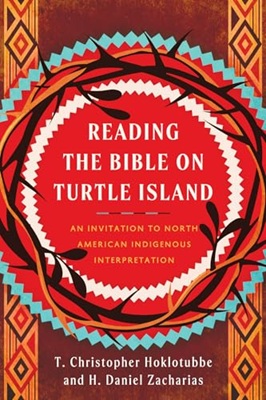
Reading the Bible on Turtle Island: An Invitation to North American Indigenous Interpretation, by T. Christopher Hoklotubbe and H. Daniel Zacharias (InterVarsity Press, 2025)
“What does it look like to be authentically Indigenous and a follower of Jesus?” [p. 160]
The authors explore this question with an approach that “invites Indigenous Christians to hold together both our Indigenous and Christian identities when we interpret Scripture” instead of going with the default “Euroamerican” interpretation. [p. 102]
From the forward, by Shari Russell:
“Danny and Chris seek to build bridges between Christian understandings and Indigenous perspectives, showing the breadth, depth, and inclusivity of the gospel’s invitation.” [p. xi]
Reading the Bible on Turtle Island is a book for two groups: Indigenous and non-Indigenous. In other words, everyone can find something useful in its pages.
From the authors:
“We hope that this book is received as an invitation for Indigenous followers of Christ to read Scripture in light of their own ancestral wisdoms, stories, and ceremonies.” [p. 188]
T. Christopher Hoklotubbe and H. Daniel Zacharias are scholars who researched heavily to bring balance and clarity to a small part of the vast intricacy of their subject. They delved deeper than reading—they spent much time listening to the stories and learning from elders and peers in Canada and the United States.
They’re also two ordinary North Americans living the ongoing reclamation of their Indigenous cultural heritage. This is why I say what they’ve written is for everyone.
Although some of the concepts went a little over my head, my heart caught the stories. I’ve peeked into another culture’s understanding and experiences, and I have so much more to learn. (Note for the sensitive: When necessary, the book refers to Indigenous suffering but in ways that neither traumatize nor inflame.)
Readers will encounter concepts like asset-based vs. deficit-based theology (God’s intent for good vs. humans’ sin), nature’s living parables, reading Scripture with the heart, and perhaps my personal favourite: how “the blood of Jesus purifies” vs. being to “placate the wrath of an angry God.” [p. 66]
This book is an incredibly rich treasure. I hope it will speak wholeness where harm still lingers and unity in place of suspicion. May its impact be great as the conversations continue.
My own roots are mainly 1750s settlers, giving me many generations of history in the Mi’kma’ki region. Yet I still lack the rootedness to the land which forms so much of the Indigenous understanding.
Reading this book revealed many ways my understanding has been shaped by Euroamerican culture and assumptions. And the corresponding “colonizing” form of Christianity where ways that might actually be complementary must be cut off because the “colonizers” don’t understand them.
As well as informing my awareness, the authors have shown me areas of my faith where colonialist roots can be replaced by attitudes better aligning to the ways of Jesus. I’m grateful.
Reading the Bible on Turtle Island is amply stocked with footnotes. Most cite sources, at times giving additional content. But there are some surprise chuckles as these two writing friends occasionally poke fun at one another.
T. Christopher Hoklotubbe and H. Daniel Zacharias are university professors (Cornell College, Iowa and Acadia Divinity College, Nova Scotia) and also on faculty with NAIITS: An Indigenous Learning Community. Visit the InterVarsity Press site to view a one-minute introduction from the authors and to preview the first chapter for free. And click here to read an interview with Danny Zacharias.
[Review copy from my household library.]
