Tips and Links on Writing Fiction

I took in as many writing workshops as I could at this year’s Hal-Con science fiction/ fantasy/ gaming convention. Many of the writing tips apply across fiction genres, so I thought I’d share some of my notes:

From C. S. MacCath: a great overview of open-source (or minimal cost) software for things like organizing notes, story creation, mind mapping and backups. See her Technology for Writers page on her website.

From Matt LeDrew and Ellen Curtis of Engen Books:

  • Sometimes, instead of a villain, you need a foil for the main character.
  • Find out who your characters are outside of the story.
  • If your characters are too similar, let that type be your main character (MC); designate another to always agree, another to always want to prove MC wrong, and another to have yet a different quirk. (Not to create plastic characters, but to train yourself to write with variety. You can edit any stiffness out later.)

From Elizabeth Moon (who was not at the convention, but whose novel, Engaging the Enemy, I slipped off to read between sessions):

  • Two characters had different strategies to understand their enemy. Both points made good sense for a writer presenting a character:
    • “What he does tells us who he is, what he’s really like.”
    • “What he wears tells us who he thinks he is.”

From Brandon Sanderson:

  • Revolve your plot around conflict.
  • Don’t make your main character an observer; make her the centre of the conflict. She needs to make the plot move, although the story opening can be a call to action where she’s pushed into the plot.
  • Story structure needs to maintain a good sense of progression on multiple levels; the reader’s feeling of movement is what keeps him turning pages.
  • What does the character want, and why can’t he have it?
    • what does he want = larger than this story’s plot
    • why can’t he have it = plot
    • Be intentional in your story opening about the promises you make; fulfill them.
      • genre/ feel/ style
      • make sure your ending wraps up what your opening raised
      • Nest multiple plot threads by priority (start the most important first, end it last)
      • Videos of his 2012 writing lectures are posted at Write About Dragons.
      • He’s one of the team at Writing Excuses (podcasts and news updates). I love their tag line: “Fifteen minutes long, because you’re in a hurry, and we’re not that smart.”

Random bonus photo: Hal-Con’s mascot, Nelson, with my Adventure Sheep, Acton, at a Hal-Con fundraising barbecue hosted by the fine folks at Giant Robot Comics.

Hal-Con's Mascot, Nelson, with Acton the Sheep

Hal-Con’s Mascot, Nelson, with Acton the Sheep

Save

Transplanted to Flourish

For [the godly] are transplanted to the Lord’s own house.
They flourish in the courts of our God.
Even in old age they will still produce fruit;
they will remain vital and green.
They will declare, “The Lord is just!
He is my rock!
There is no evil in him!”
Psalm 92:13-15, NLT*

Transplanted trees… usually they come from the nursery (or forest) with their roots in a ball of dirt. Scrawny ones may be pulled out of poor soil with bare roots, or their roots may even need washing before being plunged into good ground.

It’s amazing that God would take humans in all our messiness, clean us and label us “godly,” and transplant us into His own house — into His presence. May we not stand there, roots clenched tight into the clot of dirt they came with. May we consciously poke our roots into the wide, deep, nourishing ground of God’s presence. May we flourish. May we thrive.

God of grace and mercy, what can we say but “Thank You”? Help us grow into all You’ve designed us to be, with our confidence fully rooted in You.

∞

With the thought of flourishing in the courts of the Lord, here’s Kutless with “Better is One Day.” This is a new version to me, and I like what they’ve done with it.

*New Living Translation (NLT) Holy Bible. New Living Translation copyright © 1996, 2004, 2007 by Tyndale House Foundation. Used by permission of Tyndale House Publishers Inc., Carol Stream, Illinois 60188. All rights reserved.

Review: Trading in Danger, by Elizabeth Moon

Trading in Danger cover artTrading in Danger, by Elizabeth Moon (Vatta’s War #1) (Del Rey, 2004)

Kylara Vatta chose a military career over the family’s interstellar shipping business. When she’s kicked out of the academy for a lapse in judgment, the best way to avoid the media frenzy is to accept her father’s assignment to deliver an old ship to a distant planet for scrap.

The job comes with a Captain’s rank and a seasoned crew. The ship’s not in too bad a shape, but it won’t pass its next inspection without expensive repairs. If Ky can pick up some good trades en route to the scrap yard, she could buy the ship herself, fix it up and go independent.

Following the family mantra of “trade and profit” puts Kylara and crew in the middle of an unforeseen interplanetary war. A civilian captain without Ky’s military training would panic and be killed. Young though she is, Kylara has a chance of bringing her crew out alive.

As well as action and adventure, the novel provides an interesting look at cultures, trading customs, and diplomacy. Characters are nominally religious, although that means choosing a sect to suit one’s philosophy. There’s no acceptance of an actual God (or devil).

Trading in Danger is the first in the Vatta’s War series. I want to see how some of the ongoing plot threads work out, and I enjoy watching Ky in action. She’s a strong female hero and I like her style. [At the time of posting this review, I’m ready to start book 4.]

I’d suggest picking up book 2, Marque and Reprisal, with the first book. I didn’t do that, and then I read the first chapter (included at the end of book 1). Suffice to say it starts with a bang and the chapter end is not a spot you want to stop.

Elizabeth Moon writes both science fiction and fantasy. To learn more about her and her books, visit her website, appropriately named Moonscape. Her novels have won Compton Crook, Nebula and Heinlein Awards and been nominated for a Hugo. I owe a special thanks to James at Fantasy in Motion for introducing me to this author through his interview with Elizabeth Moon.

[Review copy from my personal library.]

Masquerade: Am I a Fraud? Guest Post by Deb Elkink

Masks

MASQUERADE: AM I A FRAUD?

Guest Post by Deb Elkink

My character Ebenezer MacAdam owns Incognito Costume Shop and individually recommends rentals based on a client’s personal character. He says,

I’d like to think the purpose of my costumes has been to reveal the real in this masked and disguised generation. But on a grander scale, I myself am being unmasked and my failure laid open to my own view. So many of my years I spent fearing to be discovered for the fraud I really am. Yet here it is the autumn of my life and I stand naked, as it were, before a Judge more kindly than myself. (The Third Grace, p. 74)

Eb’s words issue from a conflicted spot in my own soul. I’d like to think the purpose of my writing is to speak a message of truth to this generation and yet—like him—the very act of my service exposes me to the truth of my own shortcomings. Doesn’t my choice of words (like his choice of costumes) say more about my own heart attitude than that of the reader whose heart I’m judging?

Masked woman

  • I, too, fear being found out for the fraud I really am.

It started early in my life—this suspicion that I wasn’t all that I wished I were or that I portrayed myself to be. When I memorized my spelling list and won the elementary bee, I was self-satisfied but suspected the triumph was a fluke. When I earned honours in graduate school, I delighted in the accomplishment but credited grade inflation. Innately knowing that proficiency can become the breeding ground of pride, I tend to demur: “Oh no, I’m not that talented. It was luck. I don’t deserve the praise.”

There’s actually a psychological label slapped on this condition when it’s pathological: “Imposter Syndrome.” I rush to say that I’ve not been diagnosed; most healthy people to some degree attribute success to luck, reject compliments, or think, “Anyone could have done this.” I suspect it’s a well-intentioned attempt at humility.

  • What’s the line between humility and hypocrisy?

Jesus denounced as hypocrites those who ostentatiously fulfilled religious responsibility for public applause, describing the sanctimonious Pharisees with hearts full of greed and self-indulgence as whitewashed tombs and dirty cups (Matt. 6:2, 5, 16; 23:25-28). The word “hypocrite” comes from the Greek stage, where an actor would hold up a mask indicating one emotion while displaying a juxtaposing facial expression revealing his true feelings. “These people honour me with their lips,” Jesus said, “but their heart is far from me” (Matt. 15:8 NIV). Hypocrites receive their reward in this life; no reward awaits them in Heaven.

The deciding factor between true humility and the falseness of hypocrisy, then, seems to be the heart intention of the worshipper/writer; honouring the Lord with my lips/keyboard for temporal reward isn’t synonymous with bringing my heart close to Him. The very public nature of writing for reader feedback (comment on a blog, payment for an article, placement in a competition) forces me to investigate my motives.

Lacy Mask

  • Does my façade match my heart attitude?

The sixteenth-century Reformer John Calvin wrote in his Institutes (1.1.1-2),

Without knowledge of self, there is no knowledge of God . . . Without knowledge of God there is no knowledge of self.

The only way to know God is through His Word (Living via Written). Humility is seeing myself as I really am, in light of God’s gifting. When I look clearly and honestly at my own heart, I am driven back into the Bible, where I must face my motivation and ask myself truly:

  • Do I write for recognition by my readers or for reward by my Creator?

The stardust of long-awaited, hard-won, now-realized publication threatens to blind me. The only way I see to avoid hypocrisy—that veneer of false humility—is to face the “shaming nakedness” (as Calvin put it) of my own insufficient human efforts. This readies me for the revelation of the righteousness that exists in God alone, the thrill of embracing His gifts to me. I can see myself in perspective not as I measure up to my idea of authorial success but only as I see God’s flawless provision for my imperfection. On this basis I take joy in unearned grace (of salvation, of course, but also of ongoing achievements) while simultaneously facing my fear of exposure without hiding behind a mask of self-effacement. God is the ground of my humility, the Giver of all gifts for the purpose of His glory.

  • I find writing to be a humbling and unmasking experience.

Deb ElkinkDeb Elkink, recipient of the 2012 Grace Irwin Award (sponsored by The Word Guild) for her debut novel, The Third Grace, writes from her cottage on the banks of a creek in southern Alberta. Visit her sometime: www.debelkink.com.

The Third Grace book coverWatch the book trailer for The Third Grace, and read a review of The Third Grace. Check out all the stops on Deb’s blog tour, and maybe win a Kindle Fire HD.

Photo credits: Colourful window of masks: Deb Elkink; Lacy black masks: Lorenda Harder. Photos used by permission.

Living Rest

Those who live in the shelter of the Most High
will find rest in the shadow of the Almighty.
Psalm 91:1, NLT*

Rest. Soul-rest, rest from anxiety and striving. The kind of rest implied in “Be still and know that I am God.”

How do we get it?

Live. In God’s care.

This isn’t a pause or a passing-through. We need to consciously live… abide… dwell… in His shelter.

It requires gratitude, confidence in God, hope and trust in Him. It enables us to bring Him our needs as a child to a loving parent: with assurance that He listens, loves and knows best.

God who loves us and who is our Good Shepherd, help us live in Your shelter. Your power is great and You are all wise. Teach us who You are, so we can trust You more. Help us rest in Your care.

∞

Here’s Steve Green with “Jesus, I am Resting, Resting.”

*New Living Translation (NLT)Holy Bible. New Living Translation copyright © 1996, 2004, 2007 by Tyndale House Foundation. Used by permission of Tyndale House Publishers Inc., Carol Stream, Illinois 60188. All rights reserved.

Review: Double Blind, by Brandilyn Collins

Double Blind cover artDouble Blind, by Brandilyn Collins (B&H Publishing Group, 2012)

Lisa Newberry is a wreck. In recent years she’s had three miscarriages, lost her husband in a car accident, and barely survived a mugging. Depression is crushing her and she’s desperate and alone.

Her last hope is a clinical trial for a revolutionary new treatment for depression: a tiny electronic chip implanted in her brain. The chip works. But it also gives her visions—memories—of a murder.

Who is the dead woman? Has her body been found? And who killed her? Does he know Lisa has his memories through the tainted chip? Is he coming for her next?

As a suspense novel, Double Blind rates highly—no surprise for Brandilyn Collins fans. It’s a page-turning, bedtime-delaying read. The plot is fast, believable and nicely convoluted. But it’s more than just an exciting story. This is one of those potentially life-changing novels for a lot of readers.

Lisa’s recent life events have only added to self-worth pain from her childhood (raised by a single mother who found fault instead of praise). Negative thought patterns and emotions have deepened the original hurts. She doesn’t feel God anymore and believes He’s left her.

Her mother barges back into her life and learns about the visions. While the two women try to solve the mystery, they’re also repairing their relationship.

Lisa learns (and teaches us by example) to stand up for herself and to reject self-defeating behaviours. She learns to trust that God is always with her, even when her feelings disagree. Her mother learns a few parenting skills. All these are minor threads, rising naturally from the characters’ personalities and experiences. Double Blind is not a preachy novel, nor one filled with plastic-perfect examples that shame readers in our imperfect states.

It may seem odd that Lisa wasn’t under a doctor’s care for depression in the first place. I think it’s because the traumas were so recent and she’d withdrawn herself. Even her closest friend didn’t realize how bad things were.

Double Blind is the newest novel from Seatbelt Suspense® novelist Brandilyn Collins. You can learn more about the author at her website or find her Facebook page. You can also read an excerpt from Double Blind.

[Review copy provided by The DeMoss Group for a fair review.]


In the Hard Times

Crow in the rainThese days I have two prayer lists near to my heart: eight teens numbing their pain with choices that make it worse, and five couples dealing with serious illness. And a third mini-list of friends with heavy burdens.

Trouble is alive and well, and what do we do about it? We can’t wish it away, and we can’t turn into whiners. Here are three posts that pointed me in the right direction this week:

Why do bad things happen? Glynis Belec knows there’s no easy answer and yet she finds strength to face a new round of battle. Bitter-sweet (at My Journey)

In the middle of global or personal suffering, how do we cope? Violet Nesdoly shares the value of a good lament. Job’s Lament (at Other Food: daily devo’s)

Mary DeMuth’s open personal lament shows the difference bringing our hurts to God can make. A Mourning Prayer (at Live Uncaged)

Of the many “songs for the hard times” the one I’m hearing today is from the Newsboys: “When the Tears Fall.”

Where the Heart is

Lord, through all the generations
you have been our home!
Psalm 90:1, NLT*

My Bible labels this psalm “a prayer of Moses, the man of God.” Moses, who led the Israelites out of slavery to wander in the wilderness en route to the Promised Land.

These people had no geographical home, but God’s presence led them day and night. God spoke to them. God defeated their enemies and provided food and water in the desert. He even kept their shoes from wearing out from all the walking.

Circumstances may have made it easier for Moses to see God as his home, but even though I have a warm, snug, physical home I share with a loving family, God is my deeper home.

Creator and Sustainer God, I praise You that You never change. Thank You for being my home in the emotional and spiritual sense, my heart’s home, my security and stability, where I can rest and thrive and shelter.

∞

This week’s song is a mainstream love song that doesn’t totally translate as a worship song, but it captures the depth of “home” that our God is for us: Billy Joel’s “You’re My Home.”

*New Living Translation (NLT)Holy Bible. New Living Translation copyright © 1996, 2004, 2007 by Tyndale House Foundation. Used by permission of Tyndale House Publishers Inc., Carol Stream, Illinois 60188. All rights reserved.

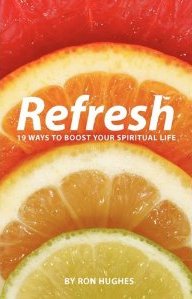
Refresh: 19 Ways to Boost Your Spiritual Life

Review: Refresh, by Ron Hughes

Refresh: 19 Ways to Boost Your Spiritual LifeRefresh: 19 Ways to Boost Your Spiritual Life, by Ron Hughes (Gospel Folio Press, 2011)

Who doesn’t need a bit of spiritual refreshment from time to time? Ron Hughes’ slender book, Refresh, offers simple and practical ways to deepen and grow our spiritual lives.

The author is quick to admit that he hasn’t “arrived” yet, but these practices continue to help him and can help us too. Each section can be read in a single sitting. They open with “A Story to Start” (as told by a Biblical character), followed by Biblical background, exploration and application, potential pitfalls, and “A Word of Encouragement.”

Topics include solitude, confession, service, simplicity, rest, and more. I found them easy to read and process, yet with scope for a lifetime’s practice. Refresh is a book to re-read over the years, because its truths aren’t meant for a one-shot benefit/attempt. It’s not a formula for do-it-yourself spiritual growth, but operates on the principle that “God works in us when we actively share in the process.”

Canadian author Ron Hughes is president of the Ontario-based Christian media ministry, FBH International. Refresh can be ordered from the FBH website and there’s a free downloadable workbook for individual and group use. You can read an excerpt from Refresh (a fictional account from the prodigal son’s father).

Refresh can also be ordered through Amazon.ca and through your local Christian bookstore.

[Review copy from my personal library. This review originally appeared in the July/August 2012 issue of Faith Today.]

Wise Words on Negative Thoughts

Cloudy thoughts block the Light

Photo credit: Janet Sketchley

God’s been challenging me lately about negative thought patterns. It’s no surprise, then, that I’d start noticing other posts on the subject. Here are a few that have spoken to me this week:

Gladwell Musau points out that indulging in our own thoughts and opinions can actually quench the Holy Spirit. (Rainbow Gulf of Love: The Problem of Self)

In a post about the power of Scripture, Violet Nesdoly shows how “our own plans, ambitions, and the ways and means of achieving them (even at unspoken levels)” can keep us from God’s rest. (Other Food: daily devo’s God’s Paring Knife)

Melody Roberts gives a stiking visual illustration of the “trail of bad-attitude ooze” we can leave if we’re not submitting our thoughts to Christ’s control. (Melody Roberts’ Blog: Can I Get a Replacement for That?)

Carolyn Watts asks if we’re hurting God by the thoughts we think about ourselves. (Hearing the Heartbeat: A Surprising Way to Love God)

And Mark Shields reminds us of our weapons for this spiritual battle. (This Day With God: Weapons Against the Competition)